


In every real estate transaction in Spain, both parties always wonder what the buyer pays and what the seller pays when selling a home. It does not matter whether you have already carried out this transaction several times in your life or it is your first time, this question is always in the air, due to constant changes in laws and regulations that always make you doubt.
And it is logical for you to be concerned or have doubts, because you not only have to look at the price of the property: taxes, notary fees, land registry, mortgage, certificates and possible outstanding charges also come into play, which can increase the cost in the case of a purchase or reduce the profit in the case of a sale.
As a general rule, the buyer usually assumes the acquisition taxes and the expenses necessary to register the property in their name, while the seller is usually responsible for the municipal capital gains tax and Personal Income Tax (IRPF) if they obtain a capital gain. Even so, the exact distribution changes depending on whether the property is second-hand or new-build, whether there is a mortgage, whether we are talking about subsidized housing, or whether both parties agree to something different in the contract.
In addition, it is worth remembering that many amounts depend on the autonomous community. In Valladolid, the general framework is the same as in Spain, but with one difference: taxes transferred to the autonomous communities, such as ITP and AJD, have their own rates. At present, in Castilla y León the general ITP for second-hand homes is 8%, and the general AJD for notarial deeds is 1.5%, with reduced rates in certain cases involving a primary residence, young buyers, large families, people with disabilities, or protected housing.
We explain all of this in more detail below, keep reading!
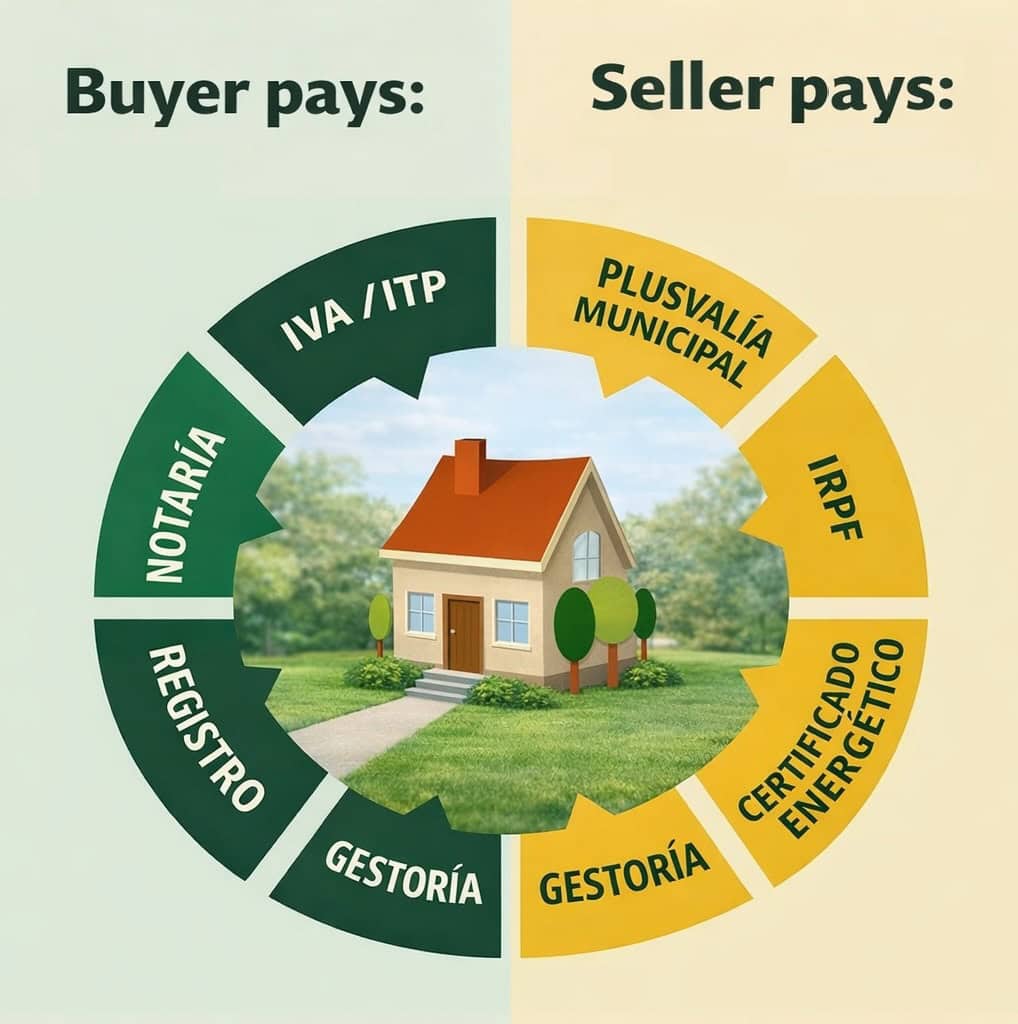
Summary table of what the buyer pays and what the seller pays for a home
First, from Ker2000 we wanted to show you this summary table in a very visual way about who pays the purchase and sale costs in the different possible scenarios: second-hand homes and new-build homes.
The distribution of notary fees you will see below is based on article 1455 of the Civil Code, and for mortgages the regulations in force since Law 5/2019 and the information from the Bank of Spain apply.
| Concept | Paid by Buyer | Paid by Seller |
|---|---|---|
| Purchase taxes | ITP (depending on the autonomous community) if it is second-hand VAT + AJD if it is new-build |
|
| Notary fees for the sale | First copy and subsequent copies | Execution / Original deed |
| Land Registry | Yes | |
| Administrative agency | Optional, if hired | Only if hired by the seller |
| Valuation (if there is a mortgage) | Yes | |
| Mortgage arrangement costs | Opening fee | |
| Municipal capital gains tax | No, except in special cases | Yes, with nuances |
| Personal Income Tax (IRPF) on capital gains | Yes, if there is a gain and no exemption applies | |
| Energy certificate | Yes | |
| Cancellation of charges | Only if agreed or if the buyer is subrogated | Yes, if the property is sold free of charges |
Buyer’s costs when purchasing a home
Now that we already know a little about the buyer’s costs when purchasing a home, let us explain more specifically what amounts we are talking about.
Taxes
If the property is second-hand, the buyer pays ITP. In Spain there is no single rate, because it depends on each autonomous community. In Castilla y León, and therefore also in Valladolid, the current general rate for second-hand homes is 8%.
In Castilla y León there are also very interesting reduced rates for primary residences. For example, ITP can fall to 4% in some cases involving buyers under 36 years of age, large families, people with disabilities or protected housing, provided the required conditions are met. There is even a super-reduced rate of 0.01% for certain young buyers purchasing their first primary residence if they meet the conditions established by the regional government.
If the property is new-build, the buyer pays VAT and AJD. In Spain, the general VAT rate for new homes is 10%, although it falls to 4% for specially protected housing or publicly promoted housing. In Castilla y León, the general AJD rate is 1.5%, with reduced rates of 0.5% in certain cases involving a primary residence and a super-reduced rate of 0.01% in very specific situations.
Notary
In the deed of sale, the traditional legal distribution is established by article 1455 of the Civil Code: the costs of executing the deeds correspond to the seller, while the first copy and any subsequent copies correspond to the buyer, unless otherwise agreed.
As for the cost, notarial fees are regulated and are not freely set. As a practical guideline, in Valladolid these notary costs are usually in an approximate range of 600 to 1,000 euros in many transactions, although the final amount depends on the value of the property and the document.
Land Registry
Registering the property in the Land Registry is also usually the buyer’s responsibility, since the buyer acquires the right and has the greatest interest in ensuring that it is perfectly protected against third parties. Here too we are talking about a cost regulated by tariff. As a practical reference, for average-priced homes it usually ranges between 400 and 700 euros, depending on the purchase price.
Administrative agency
The administrative agency is not always mandatory. In many transactions, it is hired for convenience in order to settle taxes, process deeds and register the property. The amount is not legally fixed, so it depends on each agency’s fee.
Valuation
If the buyer needs a mortgage, they will normally have to pay for the property valuation. The Bank of Spain explains it explicitly: “the valuation must be carried out by a company independent from the lender and the cost is borne by the customer”. This is important because it remains one of the most common costs borne by the buyer when financing the transaction.
Do you know the difference between appraisal value and market value? We explain it here
Typical mortgage costs
Here it is important to clearly distinguish between the costs of the sale and the costs of the mortgage. Since Law 5/2019 came into force, the distribution of mortgage arrangement costs changed: the buyer pays for the valuation and the opening fee if applicable, while the bank assumes the notary, registry, taxes and administrative agency costs of the mortgage deed.
| Buyer’s cost Example based on a home worth €100,000 |
Best-case scenario | Worst-case scenario |
|---|---|---|
| ITP if you buy a second-hand home | €10 (0.01%) |
€8,000 (8%) |
| VAT + AJD if you buy a new-build home | €4,010 (VAT 4% + AJD 0.01%) |
€11,500 (VAT 10% + AJD 1.5%) |
| Notary fees for the sale | €600 | €1,000 |
| Land Registry | €400 | €700 |
| Administrative agency | €0 (if you do not hire one) |
€400 |
| Valuation | €0 (if there is no mortgage) |
€600 |
| Total buyer cost if it is a second-hand home | €1,010 | €10,700 |
| Total buyer cost if it is a new-build home | €5,010 | €14,200 |
Seller’s costs when selling a home
The seller also has a significant share of costs. Sometimes people think that selling simply means collecting the price and signing, but that is not the case. In a sale in Spain, the seller may have to assume the municipal capital gains tax, Personal Income Tax (IRPF) if there is a capital gain, the mandatory documentation, and the cancellation of charges if the property is not transferred free and clear.
Municipal capital gains tax
The municipal capital gains tax or IIVTNU is paid by the seller, but there are two important nuances:
- The first is that, if the seller is an individual who is not resident in Spain, the person obliged to pay becomes the buyer as substitute.
- The second is that this tax revolves around the increase in the value of the land and there are cases of non-taxation or exemption that should be reviewed in each case. In Valladolid, moreover, it is a municipal tax managed by the City Council.
Personal Income Tax (IRPF) on capital gains
If the seller obtains a profit from the sale, that gain may be taxed in Personal Income Tax (IRPF) as a capital gain.
However, there are exceptions. The Tax Agency reminds us that the gain from the transfer of the primary residence may be exempt if the seller is over 65 years old or if it is a person in a situation of severe dependency or great dependency. There may also be an exemption for reinvestment in a new primary residence if the requirements are met.
Energy certificate
In a sale, the seller must provide the essential documentation for the property. The Notariat reminds us that the notary will request from the seller the energy efficiency certificate and that it must be delivered to the buyer.
Cancellation of charges if there are any
If there is a registered mortgage, an attachment, or any other charge on the property, the seller will normally have to resolve it if they are selling the property free of charges.
Real estate agency fees
If a real estate agency is involved, the fees will depend on what was agreed in the intermediation contract. In many sales the seller assumes them, although this is not always necessarily the case.
| Seller’s cost Example based on a sale for €100,000 |
Best-case scenario | Worst-case scenario |
|---|---|---|
| Municipal capital gains tax (IIVTNU) depends on the cadastral value of the land and the years of ownership |
€0 | €3,000 |
| Personal Income Tax (IRPF) on capital gains high example: gain of €30,000 without exemption |
€0 | €6,180 |
| Energy certificate | €0 (if you already have everything up to date) |
€150 |
| Registry cancellation of mortgage or charges | €0 | €1,000 |
| Total seller cost | €0 | €10,330 |
Buyer’s and seller’s costs in special cases
Of course, there are always special cases that change what the buyer pays and what the seller pays for a home, such as these:
Subsidized housing and regional tax benefits
Protected housing requires special care, because there may not only be tax advantages, but also limitations on price, use or transfer. At the national level, the AEAT reminds us that some specially protected or publicly promoted subsidized homes may be taxed at 4% VAT instead of 10%. And in Castilla y León there are specific tax benefits in ITP and AJD for protected housing and other specific profiles.
If the buyer assumes the seller’s costs
A different distribution from the usual one may be agreed, because the Civil Code itself speaks of “unless otherwise agreed”. Even so, the advisable thing is for everything to be made very clear in writing from the deposit contract onward, to avoid surprises at the notary’s office.
Homes for sale in Valladolid
Now that you know what the buyer’s costs are when purchasing a home… do any of the homes we currently have for sale suit you?
Finally, we leave you with a video from mortgage broker Antonio Domenech explaining everything we have written in this article: